When I first joined the Epiphany Movement Center towards the end of the pandemic, I came for the Pilates. Prior to lockdown, I had been taking Reformer and Wunda Chair classes at a different studio, which folded towards the end of the twenty-teens. I thought, when I started here, that I might eventually try out the GYROKINESIS® Fundamentals class being offered that session, mostly because I was curious about the odd-looking tower-and-bench equipment, but I doubted it was going to be for me.
Boy, was I wrong. Today, I’m a client at the Epiphany Movement Center because of the GYROTONIC® Method classes; the Pilates classes are just a bonus feature.
My conversion was not instantaneous. I did not take one GYROKINESIS® class only for the heavens to open up and the light of knowledge to shine down on me. In fact, despite being a former dancer, my first class was a whole lot of discombobulated confusion as I found myself pouring with sweat even though I’d spent the entire class sitting on a stool trying to remember which chakra was which. It wasn’t until a couple of days later, when I could suddenly turn my torso to my left in a way I hadn’t been able to since 2020, that I realized I was totally signing up for more.
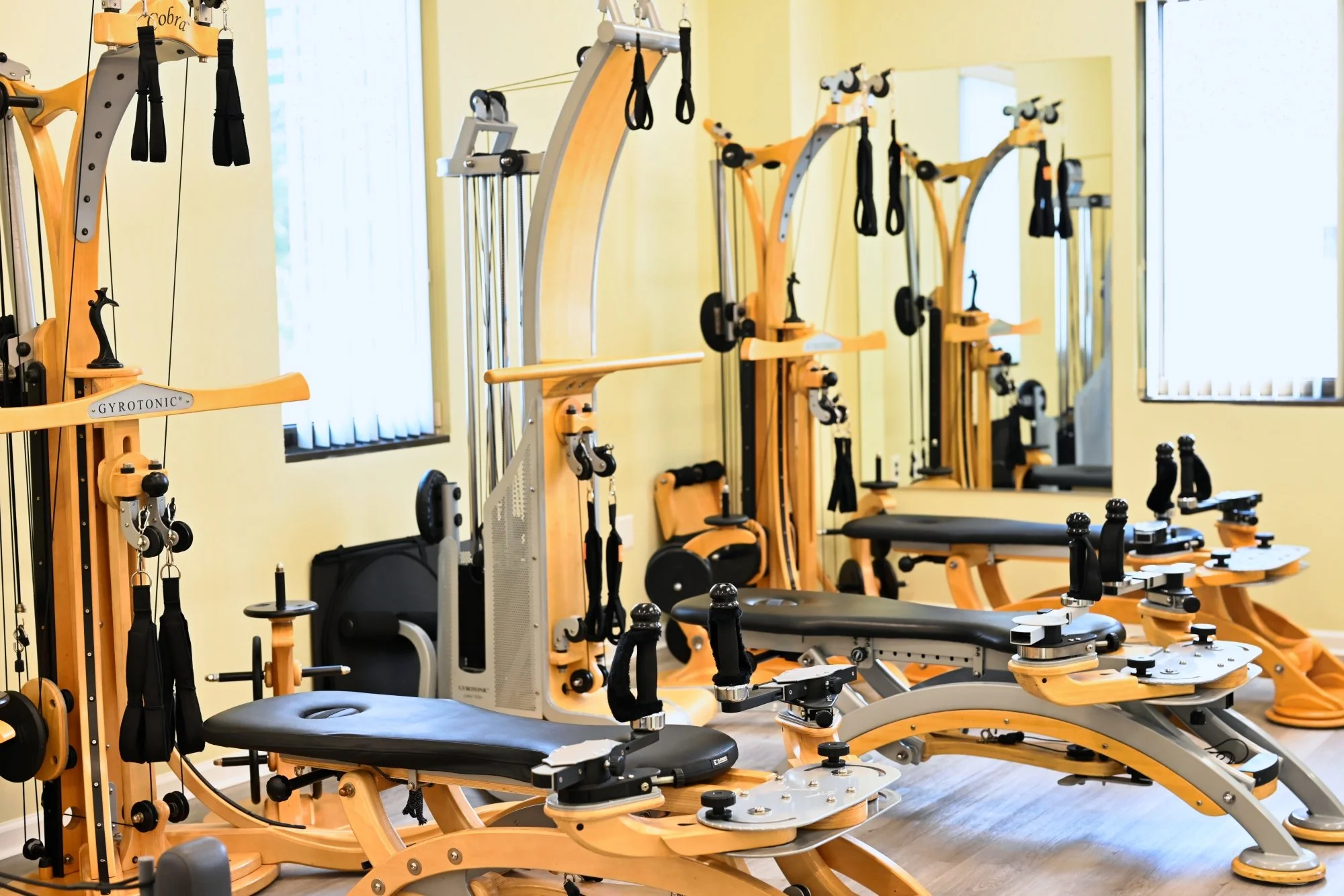
(I personally think the bench and tower look like the exercise equipment Frodo would find if he tried to use the Elven Gym at Rivendale, but your mileage may vary.)
The GYROTONIC® and GYROKINESIS® Methods are two different versions of the same discipline; I liken it to Pilates Tower versus Pilates Mat. The GYROKINESIS® method is the mat-and-stool version, while GYROTONIC® exercises use the bench and tower. Currently, Epiphany Movement Center offers the GYROTONIC® class for the Fundamentals course, but both work equally well in teaching the basic movements: The Arch-and-Curl, the Spiral, and the Sideways Arch.
These three basic moves are also what set the practice apart from Pilates. Pilates is about keeping your core square; on the Reformer, for example, you keep your torso stable as you lie on the carriage. But during GYROTONIC® movement, it is all about spinal motion, arching your spine forward, curling it back, bending it side to side, and twisting your torso around to let it spiral. At first, Arch and Curl barely feel like anything, just a gentle tilting of your hips back and forth, a soft stretch of your muscles back and forth in a repetitive motion while you “narrow” (a fancy word for making sure your body posture is aligned).
But therein lies the trick: The class is all about doing those stretching movements, over and over, trying to stretch just a tiny bit further each time, until the basic act of the stretch becomes a workout. Suddenly, (usually around 40 minutes in if you’re me), you’ve chugged an entire bottle of water and are drenched like you ran a marathon, despite the hardest move all class being “turn to look behind you” or “draw circles on the floor with your feet while seated.”
Pilates devotees may give a little side-eye to the mention of chakras, and I will admit up front that there is definitely a bit of a “woo” aspect threaded through the GYROTONIC® Method. However, the chakras are less about mental energy and meditation than they are a shorthand for where, in your body, the movement should be centered. Doing Arch and Curls centered from your Root Center (your feet) is a very different exercise from centering them from your Solar Plexus (diaphragm) or your Third Eye (forehead).
But perhaps the most unexpected part was how much doing the GYROTONIC® methodhelped with my Pilates practice. After years of being unable to manage a proper Glute Bridge for more than five seconds, I suddenly was pulling them off no problem two months into my GYROTONIC® journey, because I had at last figured out not just how to engage my hamstrings, but how to deactivate my quads so they didn’t automatically take over. My leg work improved because my hips had finally loosened. Perhaps most importantly, narrowing finally helped my brain process what the trainer meant when she said “connect those ribs” because I’d finally been able to mentally separate where my abs ended and my hip flexors began.
Because the GYROTONIC® method is, at its core, a stretch class, it’s ideal for people who are concerned about their body's ability to handle 50 minutes of exercise. It’s also super gentle on your joints and a great starting point for those with very tight (or very weak) areas that might not be able to handle more traditional exercise classes.
I admit I am evangelical about the GYROTONIC® and GYROKINESIS® Methods, because they have made such a difference in my life and body. I truly hope you consider taking a fundamentals class and see how much of a difference it makes for you.

Ani Bundel
Ani Bundel has been blogging professionally since 2010. This is her second major independent site launch. A DC native and Keyboard Khaleesi, she spends all her non-writing time photographing her cats. Regular bylines also found on MSNOW. Subscribe to Telly Visions here if you are interested in her British TV coverage.